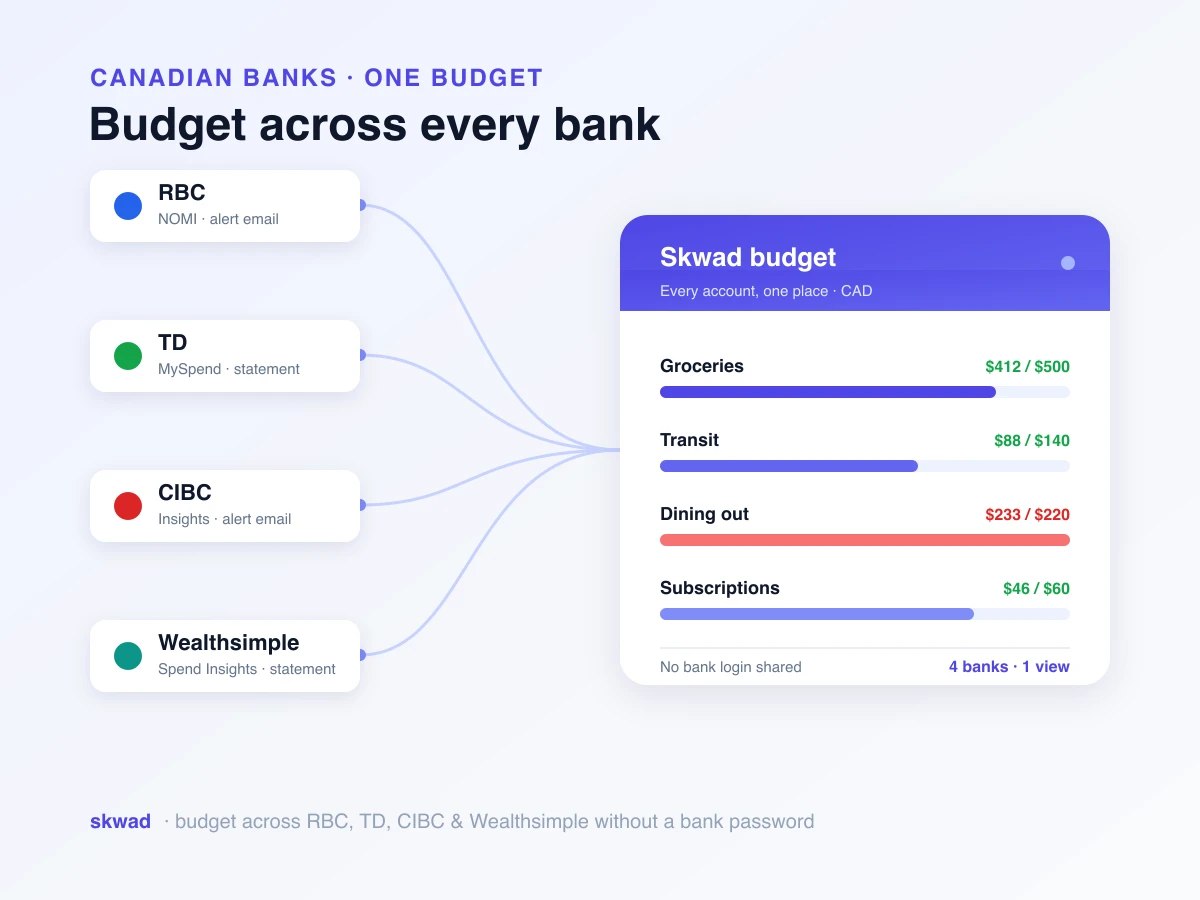

Where does all your money actually go? Cashflow Reports in Skwad answer that by tracking three connected numbers: your net income, the flow of money in versus out, and your savings rate. You might know roughly what you spend on rent or groceries, but the full picture of money moving in and out of your life is harder to see. That’s what we’re launching today.
Cashflow Reports go beyond simple expense tracking. They show your financial health by analyzing income, expenses, and the metrics that connect them. Whether you’re trying to understand why you’re not saving as much as you expected or want to find ways to improve your situation, these reports give you the numbers to work with.
What is cashflow and why does it matter?
Cashflow is the movement of money into and out of your accounts over time. Positive cashflow means you’re bringing in more than you’re spending. Negative cashflow means the opposite. Simple enough in concept, but in practice, most people have only a vague sense of their actual cashflow situation.
Understanding your cashflow is foundational to every other financial goal. Want to build an emergency fund? You need positive cashflow. Planning to invest for retirement? That requires positive cashflow. Hoping to pay off debt faster? You guessed it: positive cashflow.
Yet despite its importance, cashflow is often overlooked in favor of budgeting. Budgets are valuable tools, but they’re forward-looking plans. Cashflow reports show you what actually happened, providing the reality check that keeps your financial planning grounded in truth.
The three pillars of cashflow reports
Skwad’s new Cashflow Reports feature is built around three interconnected metrics that together paint a complete picture of your financial health.
Net income: the bottom line
Net income is the simplest but most important metric: how much money did you have left after all expenses? It’s calculated by subtracting your total outflows from your total inflows for any given period.
A positive net income means you had money left over that went to savings, debt paydown, or investments. A negative net income means you spent more than you earned, likely drawing down savings or increasing debt.
Skwad calculates your net income automatically from your categorized transactions. Income categories contribute to inflows while expense categories contribute to outflows. The difference is your net income, displayed prominently in your cashflow report.
Tracking net income over time reveals patterns that might not be obvious from day-to-day spending. Maybe your net income is positive most months but turns negative every December due to holiday spending. Or perhaps you’re consistently breaking even but not actually building wealth. These patterns become clear when you have months or years of data to analyze.
Cashflow visualization: see the flow
Numbers tell part of the story, but visualization brings your cashflow to life. Skwad’s cashflow visualization shows money flowing in and out of your accounts with intuitive charts that make complex financial data immediately understandable.
The reporting queries system powers these visualizations, with a few chart types to match what you’re looking for. Line and area charts are best for trends over time: watch your income and expenses rise and fall month by month, and spot seasonal patterns. Bar charts are better for comparisons, stacking expense types against each other or income sources side by side. And when you just want the numbers without the chart, summary views give you the key figures at a glance.
Savings rate: the metric that matters most
While net income tells you absolute dollars saved, savings rate puts that number in perspective. Your savings rate is the percentage of income that you keep rather than spend. It’s calculated as net income divided by total income.
A common benchmark is a savings rate of at least 20%. That number comes from the savings slice of the 50/30/20 rule, popularized by Elizabeth Warren and her daughter Amelia Warren Tyagi in their 2005 book All Your Worth. The ideal rate still depends on your goals, age, and circumstances. Someone aggressively saving for early retirement might target 50% or higher. Someone rebuilding after a financial setback might celebrate achieving 10% while they recover.
What makes savings rate so powerful is its ability to normalize your financial performance regardless of income level. A person earning $50,000 with a 30% savings rate is building wealth faster than someone earning $200,000 with a 10% savings rate. The percentage matters more than the absolute dollar amounts.
Skwad calculates your savings rate automatically and tracks it over time. You can view your savings rate by month, quarter, or year, watching as your financial habits improve (or spotting when they slip). This visibility creates accountability and motivation to improve.
Understanding your cashflow reports
When you access Cashflow Reports in Skwad, you’ll find a comprehensive dashboard that breaks down your financial situation from multiple angles.
Income breakdown
The income section shows all money flowing into your accounts, categorized by source. This might include:
- Salary or wages from employment
- Freelance or contract income
- Investment dividends and interest
- Rental income
- Side hustle earnings
- Reimbursements and refunds
Understanding your income sources helps you evaluate risk and opportunity. If 100% of your income comes from a single employer, you’re vulnerable to job loss. Diversified income sources provide security and flexibility.
Expense breakdown
The expense section categorizes your outflows, showing exactly where your money goes. Skwad’s category system organizes expenses into meaningful groups, and the cashflow report aggregates these into high-level summaries and detailed breakdowns.
Common expense categories include:
- Housing (rent, mortgage, utilities, maintenance)
- Transportation (car payment, gas, insurance, repairs)
- Food (groceries, dining out, delivery)
- Healthcare (insurance, medical expenses, prescriptions)
- Entertainment (streaming, hobbies, events)
- Personal (clothing, grooming, gifts)
- Debt payments (credit cards, loans)
Seeing expenses broken down by category reveals optimization opportunities. Maybe you’re spending more on dining out than groceries, suggesting meal planning could save money. Or perhaps your transportation costs are unusually high, indicating it might be time to explore alternatives.
Period comparisons
Financial data becomes most valuable when you can compare across time periods. Skwad’s cashflow reports support multiple comparison views:
Month-over-month comparisons show how this month stacks up against last, so you can spot immediate changes and respond quickly to spending spikes. Year-over-year comparisons measure this month against the same month last year, which accounts for seasonal swings and shows real progress over time. And for anything in between, custom periods let you look at a quarter, a year to date, or any date range you need to answer a specific question.
These comparisons transform raw numbers into actionable insights. A $500 increase in spending might seem alarming until you realize it’s December and the same thing happened last year during the holidays.
Using cashflow reports to improve your finances
Having access to cashflow data is just the beginning. The real value comes from using that information to make better financial decisions.
Identify spending leaks
Spending leaks are small, recurring expenses that quietly drain your finances. That $15 subscription you forgot about. The daily $5 coffee that adds up to $150 a month. The convenience fee you pay every time you use a certain service.
Cashflow reports make these leaks visible by aggregating small transactions into category totals. When you see “Subscriptions: $200/month” in your report, you’re motivated to review what you’re actually subscribing to. Most people find services they no longer use or need.
Optimize large categories
While small expenses add up, large categories often offer the biggest optimization opportunities. Housing, transportation, and food typically consume the majority of most budgets. Even small percentage improvements in these categories can mean hundreds of dollars monthly.
Cashflow reports help you benchmark your spending against your income and goals. If housing consumes 40% of your income, is that sustainable? If transportation costs rival your food budget, is there a more efficient option?
Set realistic goals
Many people set financial goals based on wishful thinking rather than data. They decide to save $1,000 a month without knowing if their cashflow even supports that target.
Cashflow reports provide the reality check that makes goal-setting effective. Start with your actual net income, then determine what improvements are realistic. If you’re currently breaking even, jumping to a 30% savings rate probably isn’t realistic. But improving to 10% might be achievable, with a path to increase over time.
Track progress over time
Financial improvement doesn’t happen overnight. It’s a gradual process of small optimizations that compound over months and years. Without tracking, it’s easy to get discouraged when you don’t see immediate results.
Cashflow reports provide the longitudinal view that shows your progress. Maybe your savings rate was 5% when you started tracking, 8% after six months of effort, and 12% after a year. Those incremental improvements represent real money and real progress toward your goals.
Cashflow vs. budget: complementary tools
Some users wonder whether they need both cashflow reports and budgets. The answer is yes, and understanding how they complement each other will help you get the most from both.
Budgets are prescriptive: They tell you how much you plan to spend in each category. They’re forward-looking tools that help you allocate resources according to your priorities.
Cashflow reports are descriptive: They tell you what actually happened with your money. They’re backward-looking tools that provide accountability and insight.
Used together, they create a powerful feedback loop. Your budget sets intentions, cashflow reports measure results, and the gap between them informs adjustments. Without budgets, you’re just observing your finances without directing them. Without cashflow reports, you’re planning without feedback.
Skwad’s budgeting system works hand in hand with cashflow reports. You can compare budgeted amounts to actual spending, identify categories where you consistently over or underspend, and use that information to create more realistic budgets over time. To set up that side of things, see Budgeting V2, and keep your comparisons honest by adjusting budgets without rewriting history.
Getting more from your financial data
Cashflow Reports are powered by Skwad’s flexible query system, which means you can customize your analysis beyond the default views.
Custom queries
Want to see spending by merchant rather than category? Curious about how your account balances have changed over time? The query system lets you slice and dice your financial data however you need.
Available data sources include:
- Net worth over time
- Spending by account, category, merchant, or tag
- Aggregate comparisons across different dimensions
- Date-based breakdowns for trend analysis
Export and external analysis
For users who want to do deeper analysis, Skwad integrates with Google Sheets for data export. You can sync your transaction data to a spreadsheet for custom analysis, pivot tables, or integration with other financial planning tools.
Privacy-first financial insights
One of the challenges with financial tracking tools is trusting them with sensitive data. Skwad approaches this with privacy as a core principle.
Our email scanning approach means you can get comprehensive cashflow insights without sharing bank credentials. For users who prefer direct bank connections, we offer Plaid integration with industry-standard security practices.
Either way, your financial data stays private. We don’t sell user data or use it for purposes beyond providing the service you signed up for. Your cashflow reports are for your eyes only.
Start understanding your cashflow today
Cashflow Reports are available now for all Skwad users. To access them:
- Navigate to the Reports section in Skwad
- Select the Cashflow view
- Choose your time period and comparison options
- Explore the income, expense, and savings rate breakdowns
For the most complete picture, make sure your transactions are properly categorized. Skwad’s auto-categorization handles most of this automatically, but reviewing and correcting any miscategorized transactions will improve your report accuracy.
Frequently asked questions
What’s the difference between a cashflow report and a budget?
Budgets are prescriptive and forward-looking: they tell you how much you plan to spend in each category. Cashflow reports are descriptive and backward-looking: they tell you what actually happened with your money. Used together, your budget sets intentions and the cashflow report measures results.
How is my savings rate calculated?
Savings rate is your net income divided by total income, expressed as a percentage. It tells you how much of what you earn you actually keep, which makes it a fair measure of progress regardless of your income level.
Do I have to connect my bank to get cashflow reports?
No. Skwad’s email scanning approach gives you full cashflow insights without sharing bank credentials. If you prefer a direct connection, Plaid is available with industry-standard security.
The path to financial health starts with understanding where you are today. Cashflow Reports give you that understanding in clear, actionable terms. Whether your current situation is better or worse than you expected, knowing the truth is the first step toward improvement.
Your money tells a story. Skwad Cashflow Reports help you read it.