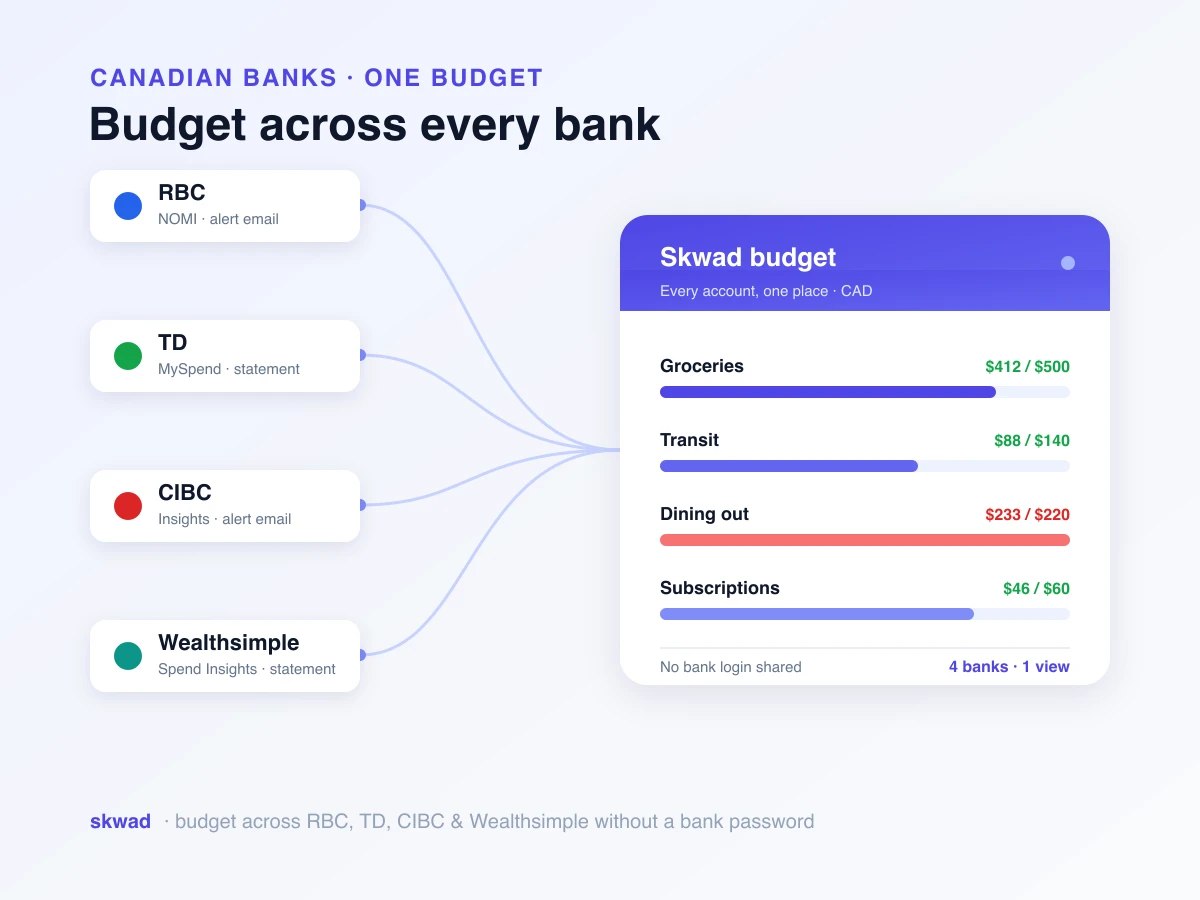

Canadian banks disconnect from budgeting apps because most apps reach your bank through a third-party data aggregator, and that link breaks whenever the bank changes how you sign in or adds a security check. Until the aggregator rebuilds it, your transactions stop coming in. Below is what to do when your bank drops off, plus how Skwad sidesteps the whole thing: we read the alerts your bank already sends.
The root of the issue: data aggregators
Your budgeting app probably isn’t reading your bank directly. Behind it sits a data aggregator, a middleman that pulls account data from the bank and passes it along. In Canada, the middlemen have struggled to keep those links stable for years. Five big banks, a long tail of credit unions, and every one of them built its online banking differently.
Banks change things all the time: a new login page, a different two-step check, an extra security screen. Any of those can snap the aggregator’s link, which is why aggregators frequently encounter connection breakdowns. Until someone on their side rewrites the integration, your app goes quiet.
When a connection breaks, your budgeting app usually can’t repair it on its own. It waits for the aggregator, and you wait with it. You set up the app, you get it working, and one morning your bank is gone from the dashboard.
What to do when your bank disconnects
- Sign in to the bank again. Open the account in your budgeting app, reconnect, and get through whatever new security step the bank added. When the break came from a changed sign-in on your end, that’s sometimes all it takes.
- Check whether your bank sends transaction alerts. Most of the big ones send one for every transaction: RBC, BMO, Scotiabank, CIBC, Desjardins, National Bank, Tangerine and EQ Bank. TD and Simplii only alert on balances. Our bank alerts list has the details for each bank.
- Forward those alerts to Skwad. Point them at your own inbox, then set up an auto-forward to your Skwad scan address. Here’s why the extra hop matters.
- Import a statement for the gaps. TD, Simplii, or anything else without full alerts: grab a statement file from online banking (OFX, QFX, QIF, CSV or Excel) and upload it to Skwad.
Reading the alerts you already get
There’s another way to get your transactions in, with no aggregator involved. Instead of connecting to your bank, Skwad reads the bank alerts and notifications you already receive, then parses and categorizes those transactions for you.
You forward (or auto-forward) those alerts to a dedicated Skwad scan inbox. Skwad picks out the merchant, the amount and the date, then files the transaction under the right category. That’s a real-time feed of your spending with no direct bank connection at all. So when the aggregators break, you don’t notice, because you were never relying on them.
It’s more private, too. You budget in full without connecting a bank account or handing anyone your login, and your data stays yours. If you’d rather not link a bank at all, you can also track balances manually.
Budgeting in Canada with Skwad
We built Skwad around the alerts your bank already sends, so it doesn’t lean on the connections that keep failing Canadians. See how it works with each bank on our budgeting app built for Canada page, or read our guide for RBC, TD and CIBC customers.
If you’re done with flaky bank syncing and want your bank login to stay yours, give Skwad a try.
Frequently asked questions
Why do budgeting apps keep losing support for Canadian banks?
Usually because the app doesn’t connect to your bank directly. An aggregator sits in the middle. When a Canadian bank reworks its online banking, its sign-in or its security checks, the aggregator’s link snaps, and nothing new syncs until they rebuild it.
Can I use Skwad without connecting my bank account?
Yes, and that’s the default. Skwad reads the transaction alerts your bank already emails you. Forward them to your scan inbox and each one turns into a categorized transaction. Nothing connects to your bank, and your login stays with you.
Does Skwad work with my Canadian bank?
Probably. Skwad tracks spending from transaction alerts, so what matters is whether your bank or card emails them, not whether an aggregator supports it. RBC, BMO, Scotiabank, CIBC, Desjardins, National Bank, Tangerine and EQ Bank send one for every transaction. TD and Simplii stop at balance alerts; for those accounts, import statements instead.