Recurring Transactions
Skwad will automatically find and group your recurring transactions after the third charge. The recurring page gives you a financial dashboard view of all your recurring expenses and income.
Dashboard Overview
The recurring page shows summary cards at the top with:
- This month — Progress bars for expenses and income, with month-over-month comparison
- Year projection — Projected annual spending with year-over-year delta
You can switch between a calendar view (default on desktop) and a list view using the toggle. The calendar shows color-coded events by type — tap any event to jump to its detail page.
Each recurring transaction's detail page shows its frequency, this-month progress, projected and lifetime totals, occurrence count, and first-seen date. You can change a transaction's type between bills and subscriptions using the type dropdown.
Recurring transactions are marked with a ↻ icon in your transactions list — both scheduled ones and series Skwad detected automatically. On web, editing a recurring transaction also shows a timeline card with the series' history and next expected charge.
Scheduled Transactions
You can schedule transactions by setting a future date. These transactions will be reflected in your trends view and will be automatically included in your budget during the appropriate period.
For example, if you schedule a transaction for next month: it won't be reflected in this month's budget. But, you'll see it in next month's budget.
Manual Recurring Transactions
You can create recurring schedules manually from the transactions edit view. Scroll down to the "Recurring schedules" section.
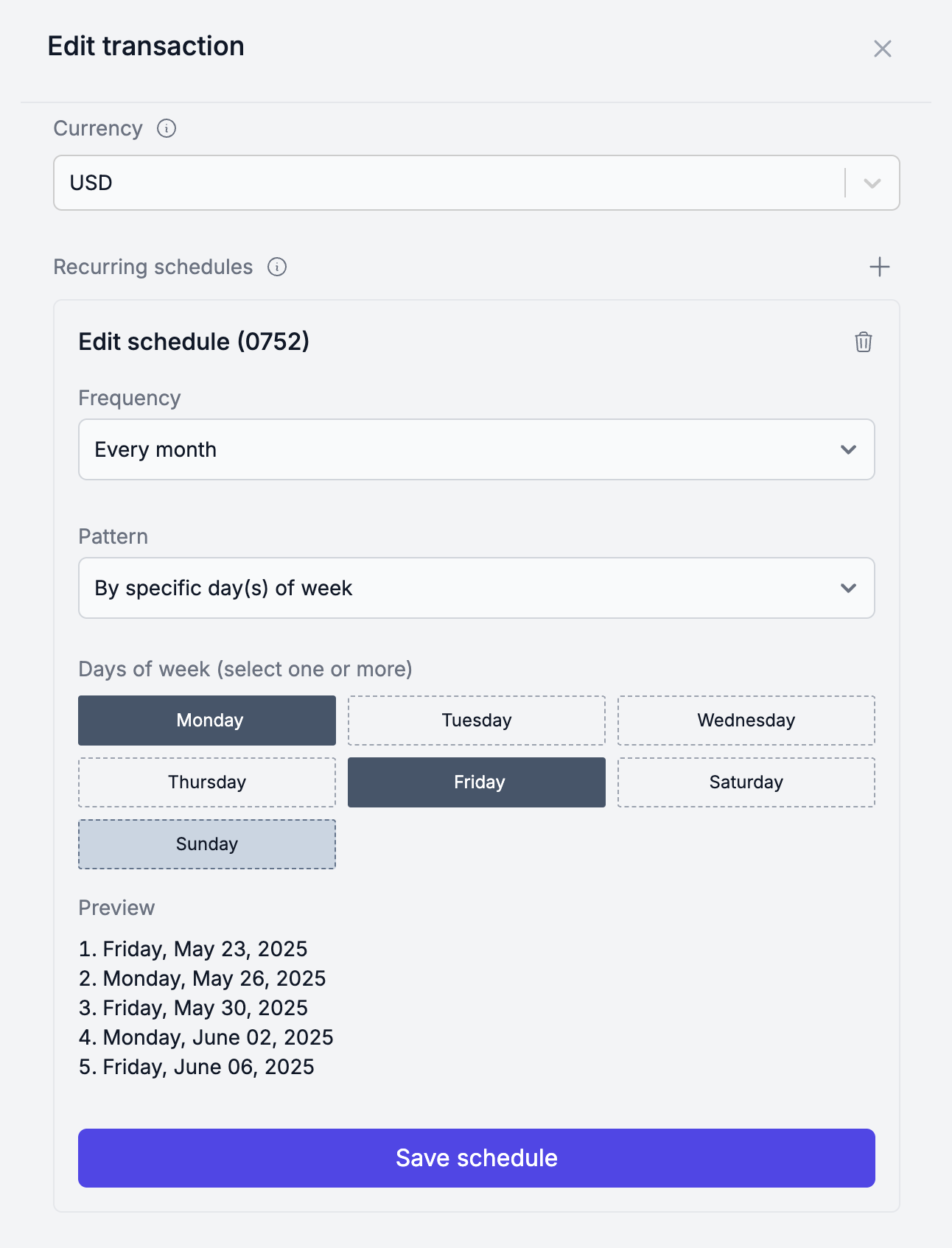
TIP: You can change how far in advance Skwad creates new scheduled transactions in your settings. The default is 7 days.
When will my scheduled transactions appear? Skwad processes recurring schedules in the background, so new scheduled transactions may take a few hours to appear after you create or modify a schedule. Don't worry—they'll show up automatically once processing is complete!
Recurring detection settings
You can adjust how Skwad detects recurring transactions by clicking the gear icon (⚙) next to the "Recurring transactions" page title. These settings are skwad-wide and can only be changed by the captain.
Auto-detect recurring
The Auto-detect recurring toggle controls whether Skwad automatically groups transactions into recurring patterns. It is on by default.
When you turn it off, Skwad stops trying to detect recurring patterns automatically. You can still manually tag merchants as recurring in the merchants view.
Minimum amount
The Minimum amount field sets a floor for auto-detection. Any auto-detected recurring transaction below this amount is ignored. New skwads start with a $15 default.
Setting a minimum is useful if you have many small, frequent charges (like $1–$2 app purchases) that you don't want treated as subscriptions.
Merchants you manually mark as recurring always appear on the recurring page, regardless of the minimum amount setting.
Setting changes take effect on your next recurring refresh, which usually happens within an hour.
Troubleshooting
Why aren't my recurring transactions being detected automatically?
Skwad requires at least 3 similar transactions to automatically detect a recurring pattern. Make sure:
- The transactions have similar amounts (small variations are okay)
- They occur at regular intervals
- The payee or merchant are consistent.
How do I edit or delete a recurring schedule?
- Go to the transaction that's part of the recurring schedule
- Tap "Edit"
- Scroll to the "Recurring schedules" section
- Modify the schedule settings or tap "Delete Schedule"
My scheduled transaction isn't showing in my budget
Check that:
- The scheduled date falls within the budget period you're viewing
- The transaction category is included in your budget
- The scheduled transaction status is "Active"
The recurring amount varies slightly each month
This is normal for bills like utilities. Skwad will still group these as recurring if the variations are reasonable.