

If you’ve used popular personal finance apps and budgeting tools, you know their biggest pain point: constant connectivity issues with banks that make you reconnect accounts and re-enter login credentials over and over. Skwad works differently, so you can track all your accounts in one place, no matter where you bank.
Other apps rely on integrations that directly sync with your online banking portals. While convenient in theory, this connectivity model is often fragile and prone to endless breakdowns. Any of a bank’s routine updates can break the connection in finance apps, forcing you to re-enter your passwords and 2FA codes for every bank account and credit card.
It’s an incredibly frustrating experience that wastes time, compromises account security by sharing login details with third parties and exemplifies the pitfalls of relying on fundamentally fragile integrations. It’s one of the reasons we cover whether it’s even safe to connect your bank to a budgeting app.
Why bank connections keep breaking
Other apps depend on a live link into your bank’s login portal, usually through a data aggregator. That link is only as stable as the bank’s website. When a bank tweaks its login flow, adds a security step, or redesigns a page, the connection drops. You find out when your transactions stop showing up, and the fix is to reconnect and re-enter every password and 2FA code again.
Skwad’s passwordless approach
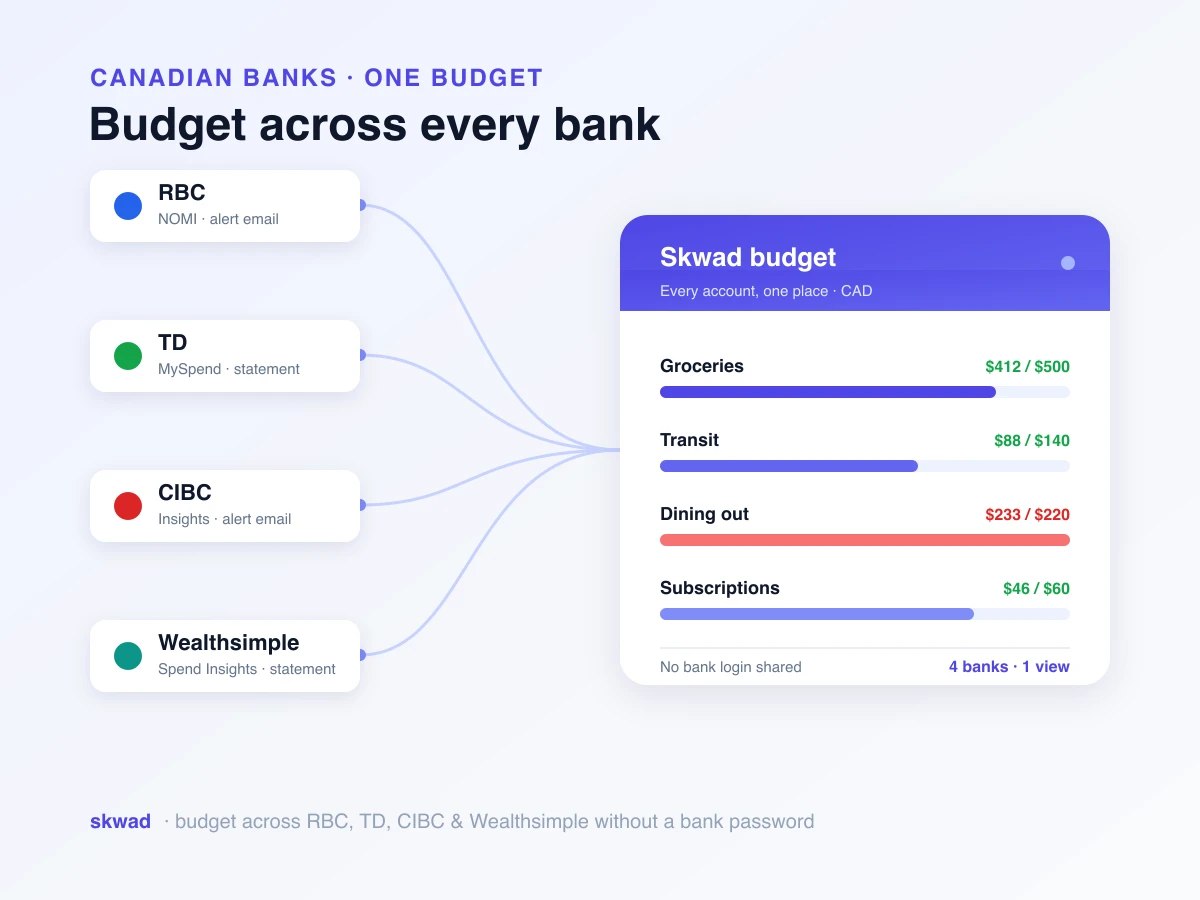
At Skwad, we knew there had to be a smarter way to give you a full picture of your finances without the headaches of direct bank connectivity. That’s why we built a passwordless approach that uses the real-time alerts and notifications your bank already sends you.
Instead of asking you to share private banking credentials, Skwad works from the deposit alerts, payment receipts, and expense notifications your bank sends directly to you.
With Skwad, you reclaim your time. Our system reads your bank’s alerts, pulling out the amounts, merchants, and payment types, then automatically categorizes and records the activity. You focus on what matters most while Skwad handles the tracking.
How it works
- You update your notifications to send income updates, payment receipts, refunds, and expense notifications to a dedicated Skwad scan email address. For instance, if you receive a notification about a direct deposit, a payment confirmation, or a refund, Skwad can process these and update your finance dashboard accordingly.
- Skwad monitors the inbox and reads each email, pulling out the important data: amounts, merchants, dates, payment types, and more. It then automatically categorizes and organizes that transaction activity into your secure Skwad finance dashboard. For example, your paycheck direct deposit notification would get forwarded from your bank to [email protected]. Skwad parses the deposit amount and categorizes it as ‘Income.’
- This process, which used to take several minutes or even hours, now happens in seconds. When you get an Uber receipt, it goes to the same email address where Skwad logs the ride as a “Transportation” expense. Your monthly Visa statement summary is processed the same way.
What this means for you
This modern, notification-driven approach means:
- No more authenticating accounts or managing connections
- No risk of exposing sensitive login details to third parties
- No hiccups from website redesigns or new security requirements
- Fully automated syncing directly from the source
Your financial life stays organized in a clean, real-time dashboard built from the updates you already receive. And since the data comes straight from the source, there’s no fragile middleware to break down. The interface is easy to navigate, so you can understand your financial situation at a glance.
With Skwad, you finally get finance tracking without the headaches of bank connectivity: no more endless cycles of reconnecting accounts to reach your financial history. We know the frustration and stress this causes, and we built a solution that spares you the work of managing multiple logins and connections.
Don’t let broken integrations and resyncing hold you back any longer. Take the first step toward a simpler financial life. Learn more about tracking spending without linking your bank, or see why Skwad is a budget app that works without Plaid.
Frequently asked questions
Why does my budgeting app keep losing its bank connection?
Most apps connect by syncing directly with your bank’s login portal through an aggregator. Any routine change a bank makes to its website, login flow, or security can break that connection, which forces you to reconnect and re-enter your passwords and 2FA codes.
How does Skwad avoid bank connection issues?
Skwad doesn’t log into your bank at all. It reads the transaction and balance alerts your bank already emails you, extracts the amount, merchant, and date, and categorizes them automatically. Because there’s no direct connection, there’s nothing to break or reconnect.
Do I have to re-enter my password when something updates?
No. Skwad never asks for your bank login, so a website redesign or new security requirement on your bank’s side won’t interrupt your tracking. You set up alert forwarding once and it keeps working.