Financial well-being
The Consumer Financial Protection Bureau (CFPB) defines financial well-being as being in control of your day-to-day finances, being able to absorb a financial shock, and having the freedom to make choices that let you enjoy life. Sight scores each of those three pillars from your Skwad data.
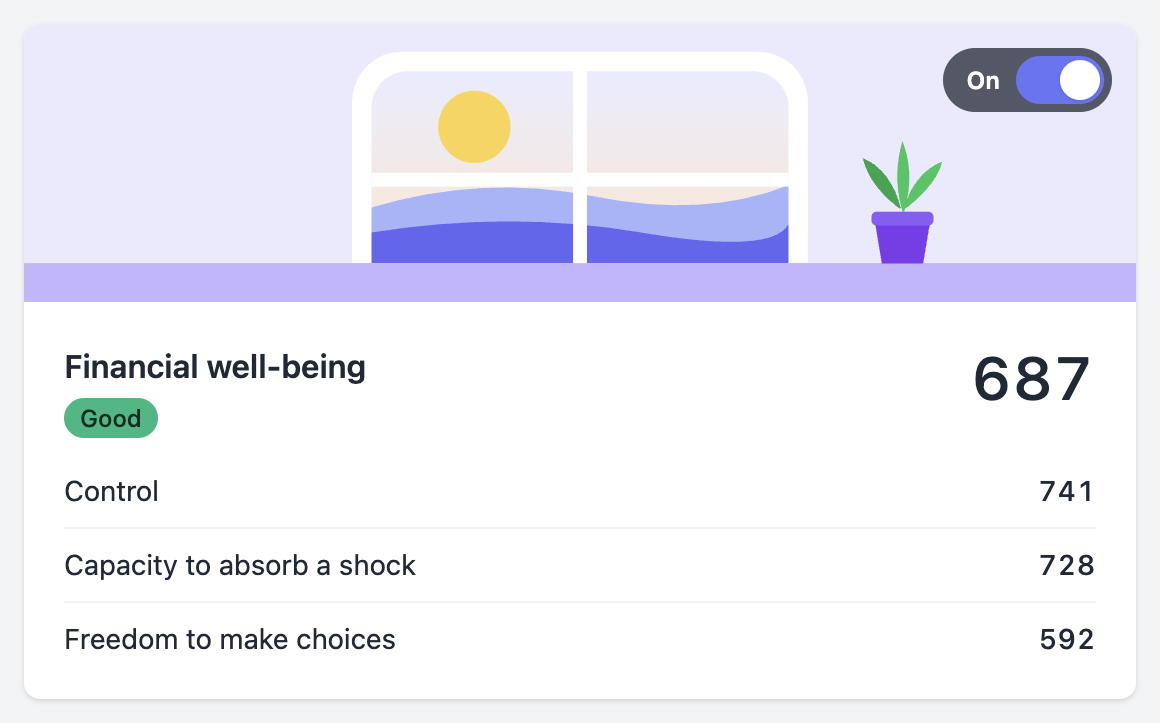
This framework is on by default. Its card shows your Financial well-being score and a score for each pillar. Click or tap the card to see the metrics.
Sight's Financial well-being score is based on the CFPB's financial well-being framework. It isn't the CFPB's survey, and the CFPB doesn't endorse Skwad.
Control
How steady your money is from month to month.
Savings rate
The share of your income you keep rather than spend. Money you move to savings or investments with a transfer between your own accounts counts as kept.
To improve it:
- Spend less than you bring in.
- Move savings with a transfer, so it isn't counted as spending.
- Make sure your paychecks are categorized as income.
- Add retirement contributions taken from your paycheck to your income & savings profile.
Fixed-cost ratio
How much of your income goes to recurring bills and subscriptions, based on your Recurring list. Charges marked Inactive there aren't counted.
To improve it:
- Cancel subscriptions you don't use, and shop around on bills.
- Keep Recurring accurate. A regular purchase picked up as a bill inflates this metric. Sharpen your score flags charges like that.
- Add your gross income to your income & savings profile, so bills are measured against your full pay.
Net-positive months
How many recent months your income was higher than your spending.
To improve it, keep each month's spending under that month's income. Spreading a large expense over a few months helps.
Capacity to absorb a shock
How long you could cover essentials if your income stopped.
Emergency-fund runway
How many months your checking, savings and cash accounts would cover your essential spending. Only categories marked as Needs count as essential.
To improve it:
- Build up cash savings.
- Trim essential costs.
- Keep your cash accounts linked and syncing.
- Check your needs and wants. A want marked as a need inflates your essentials.
Freedom to make choices
How much room you have for wants once essentials and savings are covered.
Discretionary headroom
The share of your income left for wants after essentials and savings.
More isn't always better. Too little leaves no room in your budget. Too much can mean money that could be saved is being spent. If it's low, look at your essential costs. If it's high, move some of it into savings.
Net-worth trend
Which way your net worth (what you own minus what you owe) is moving. It counts for less than the other metrics and isn't required for a score. Paying down debt, growing savings and linking all your asset and debt accounts all help.
When a metric shows as incomplete
If Sight can't score a metric yet, it shows as incomplete with what's missing, such as categorizing your income, adding recurring bills or connecting a checking or savings account. Some metrics also need a few months of history.
Incomplete metrics are left out of your score, not counted against you.
FAQ
Why does my savings rate look low when I save every month?
Savings moved by transfer between your own accounts counts as kept. Money that leaves through a spending category counts as spent. Retirement contributions taken from your paycheck only count once they're in your income & savings profile.
What counts as cash for my emergency fund?
Checking, savings and cash accounts. Investment and retirement accounts don't count.
Can I change which categories count as essential?
Yes. Open Categories, switch to the Needs/Wants view and click a category's Need badge. See Needs and wants.